Overview

lsnms speeds up NMS ran on very large images by several folds, using a sparse implementation of the algorithm.
This project becomes useful in the case of very high dimensional image data, when the amount of predicted instances to prune becomes considerable (> 100 objects).
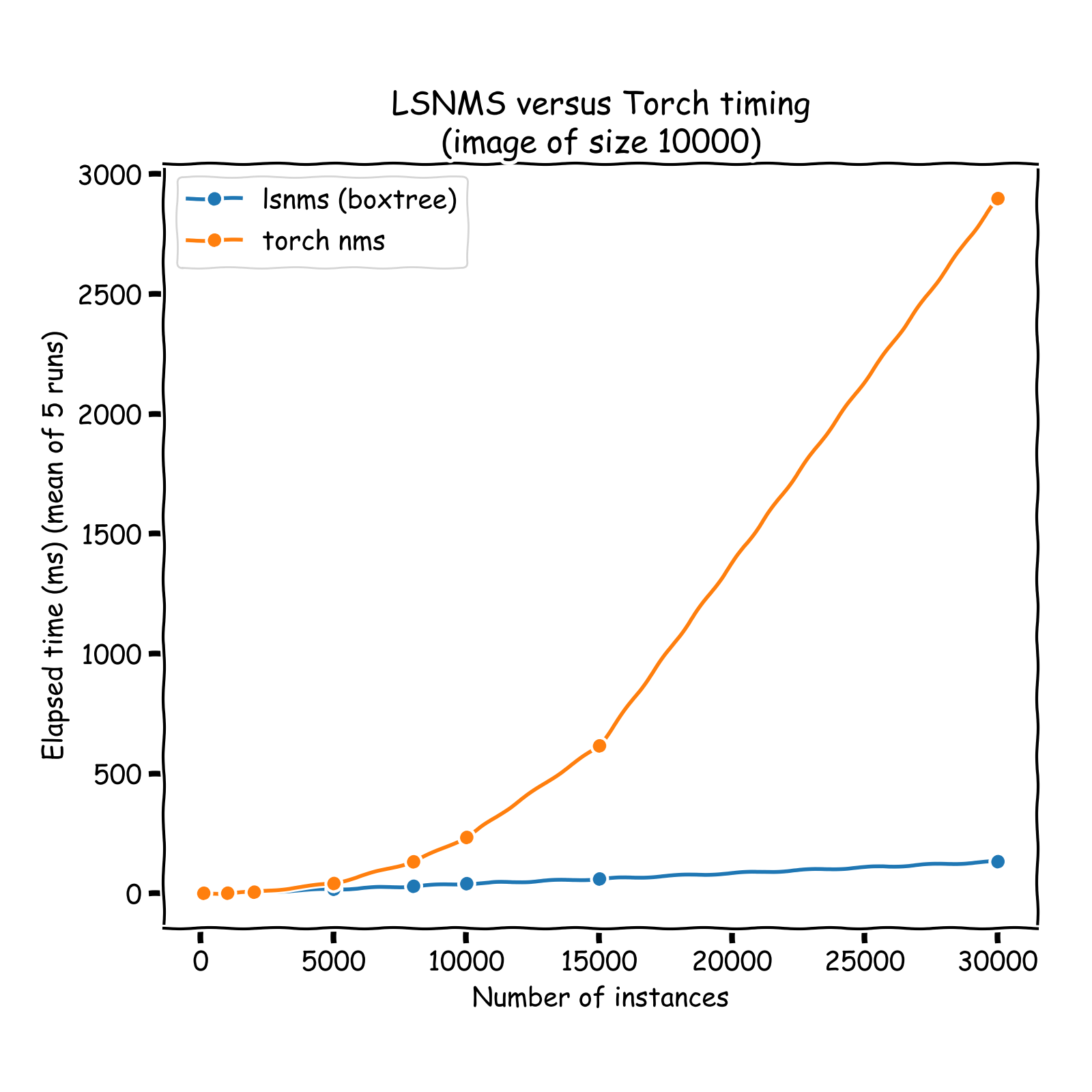
Run times (on a virtual image of 10kx10k pixels)
Non Maximum Suppression
A nice introduction to the non maximum suppression algorithm can be found here: Coursera NMS Lecture.
Basically, NMS discards redundant boxes in a set of predicted instances. It is an essential — and often unavoidable — step of object detection pipelines.
Will I benefit from this sparse NMS implementation?
From version 0.5.0, lsnms is on par with torchvision’s nms both on CPU and on GPU, even for small images (and small amount of detections). This does not account for host <-> device data transfer time. So, if you are running a vanilla object detection pipeline (i.e. single image with a GPU-based object detection algorithm): torchvision GPU-based NMS will likely be faster.